Toilet Mapping: Why the U.S. Needs a National Public Bathroom Map
-
 By
Tiff Perritt
By
Tiff Perritt
Key Takeaways:
-
Today, the U.S. still lacks a national public toilet map, putting it behind Australia’s government-run bathroom map and cities like Tokyo, Japan, which offer official online maps to people in need of accessible public bathrooms.
-
In 2025, high-traffic businesses, such as Starbucks, began limiting restroom access to paying customers. In at least 20 states, Ally’s Law can still protect people with certain medical conditions when no public restroom is available.
-
If you or a loved one experiences incontinence, knowing where the nearest restrooms are can help you manage your condition, especially if you experience urge incontinence or have an overactive bladder.
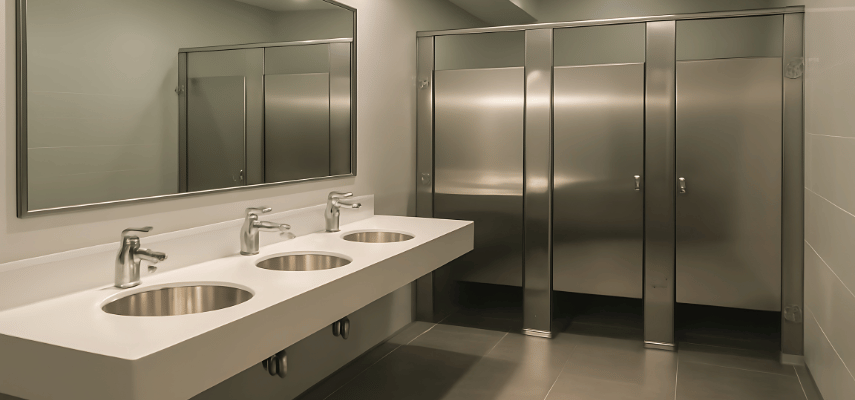
If finding a bathroom feels harder than it should, you’re not imagining it.
In much of the United States, public restroom access can still be unpredictable and stressful to plan around, especially if you or a loved one is diagnosed with a condition such as urinary incontinence or irritable bowel syndrome (IBS). It can also be challenging if you're caring for a child or an adult who may not be able to communicate their needs in time to locate a bathroom.
Meanwhile, other countries are making it easier to find bathrooms. Australia’s government funds a nationwide online public toilet map, and cities like Tokyo, Japan, have partnered with local governments to improve public toilet accessibility.
What Is Toilet Mapping?
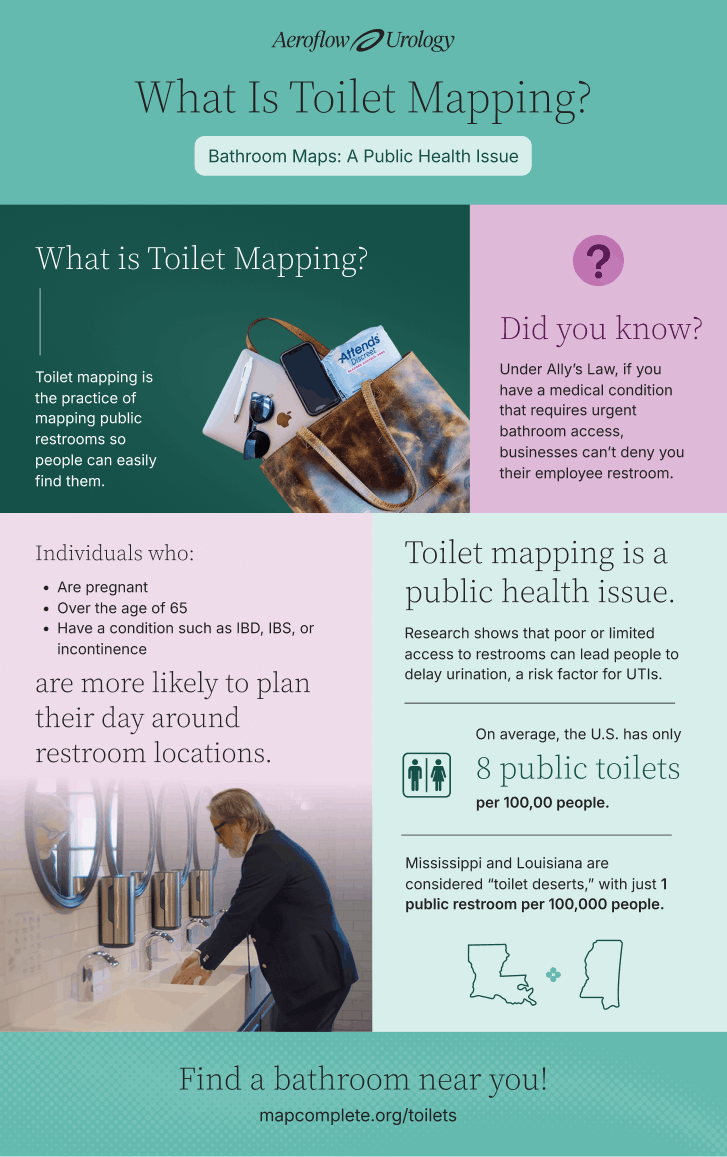
Toilet mapping is the practice of listing public bathrooms in one place so people can find them quickly and plan ahead.
If you’re diagnosed with a condition that makes it important to know where the nearest bathroom is, using an app or public restroom map can help you feel more prepared when you leave home.
“Clinically, toilet mapping can ease anxiety with finding a restroom if you’re out in public,” says Aleece Fosnight, MSPAS, PA-C, CSC, CSE, IF, MSCP, HAES. “However, becoming obsessed over bathroom access can also be a sign that a patient’s urgency isn’t being well managed, and we need to address the root cause.”
Quick bathroom access may be helpful for:
-
Digestive conditions, such as:
-
Inflammatory bowel disease (IBD), including Crohn’s disease and ulcerative colitis
-
-
Individuals with a mobility-related disability
-
Older adults
-
People who are pregnant or caring for young children
-
Anyone experiencing temporary urgency due to illness or medication
Check your coverage for $0 bladder control pads or diapers with insurance now!
Why Is Bathroom Access a Public Health Issue?
Bathroom access is easy to overlook until you need one right away.
But when restrooms are hard to find, people may delay going, stay close to home, or skip going out altogether, which can take a toll on both physical and mental health.
Some populations are also overlooked, including parents with children experiencing delays in potty training or who have developmental conditions, such as autism, that make it harder to recognize or communicate when they need to go to the restroom.
A survey by the Crohn’s & Colitis Foundation found that more than half of respondents had difficulty finding a public toilet within the last week. In fact, 72% of those who experienced a public accident said it “definitely” or “probably” could have been avoided if a restroom had been nearby.
Research has also linked delaying urination to health issues such as urinary tract infections (UTIs).
The Importance of Ally’s Law
For some people, waiting is not an option. In at least 20 states, Ally’s Law, also called the Restroom Access Act, may allow adults and kids with certain medical conditions to use an employee restroom if no public restroom is available.
That protection matters even more as some businesses with high foot traffic tighten restroom access. In 2025, Starbucks announced that its bathroom policy would change: all company-owned North American stores would be for paying customers only.
Still, access isn’t guaranteed everywhere. Ally’s Law only applies in certain states and situations, leaving many without a safety net.
Limited access also shapes everyday financial decisions. In the same study by the Crohn’s & Colitis Foundation, 61% of respondents said they’re more likely to choose a business that offers a public restroom.
The Future of Public Toilet Mapping
Public restroom maps don’t need to be complicated to be useful. At a basic level, they should tell people where bathrooms are, whether they’re open, and if they’re accessible.
Some U.S. cities are starting to take steps in that direction.
New York City recently voted to establish a citywide public bathroom strategy to add more than 2,100 public restrooms by 2035.
Making public restroom information easier to find gives people the confidence to leave home and navigate public spaces without added stress. However, city-level efforts can only go so far in a country of over 340 million people.
What About Toilet Finder Apps?
Toilet finder apps can be helpful, especially when you’re in an unfamiliar area and need a bathroom quickly, but their crowdsourced data can be inconsistent and difficult to verify.
Take a look at some of the differences between most toilet finder apps and official government-run apps:
| Feature | Crowdsourced Apps | State / City Pilot Programs | National Public Map (Proposed) |
|---|---|---|---|
| Cost to Access | Free or Ad-supported | Free | Free |
| Coverage | Inconsistent | Hyper-local | Comprehensive |
| Reliability | Variable (May be Outdated) | High (Within City Limits) | Verified & Real-time |
| Accessibility Info | Limited | Detailed | Detailed, Universal Standard |
| Data Source | User-generated Data | Municipal GIS Data | Centralized Federal Data |
A quick online search can point you to the nearest bathroom locations, and your phone’s built-in maps can also show you directions and hours of operation.
$0 Bladder Control Pads & Diapers With Insurance
Whether you have bladder leaks or you're the parent of a child with incontinence, finding a bathroom fast matters. But so does having the right protection in case of any unexpected leaks. If you or someone you care for has incontinence, you may be able to receive $0 bladder control pads, diapers for kids, or adult diapers.
We work directly with your insurance and healthcare provider to check your coverage for medical-grade supplies from top brands such as Prevail and Attends. If you qualify, we’ll ship your products to your door with free shipping.
Reviewing and reordering your no-cost supplies with insurance is also easy. Check if you're covered for incontinence supplies!
Frequently Asked Questions
Why is it important to plan ahead if you have incontinence?
Knowing where restrooms are in advance can help reduce stress and make it easier to manage your symptoms, especially in unfamiliar places.
I have incontinence. Why can’t I use any public restroom?
Some businesses limit restrooms to customers only. However, under Ally’s Law, which applies to at least 20 states, you may be able to use an employee restroom if you have a condition like IBD and can’t wait.
How can I use Ally’s Law?
If you or your loved one has incontinence, you’ll need to show proof of an eligible medical condition in a state that follows Ally’s Law. You can also request an “I Can’t Wait” card from the Crohn’s & Colitis Foundation.
Are toilet finder apps always accurate?
Not always. Many toilet-finder apps rely on user-submitted information, so listings can be outdated, incomplete, or lack accessibility details.
Are there any free “find a restroom” or “toilet finder” apps?
Yes, there are free apps and sites for finding a restroom near you. You can search for things like “toilet near me” or “nearby bathroom.” However, because they rely on crowdsourced information, the details may not always be complete or up to date.
About the Author
Tiff Perritt is the Content Writer at Aeroflow Urology. She writes with clarity and compassion on topics surrounding incontinence, aiming to help patients feel informed and supported. Driven by a strong interest in health equity, she supports efforts that promote education and access to incontinence care for underserved communities.
She earned her Bachelor's degree in Technical Communications from University of Houston - Downtown and her Associate's degree in English from Lee College. Her work has been featured by leading healthcare colleges and respected healthcare organizations across the country.
Outside of work, she loves to hike across the Texas landscape, try out new baking recipes, and spend time with her family.
Aleece Fosnight

Aleece Fosnight, MSPAS, PA-C, CSC-S, CSE, NCMP, IF, HAES is a board-certified physician assistant specializing in sexual medicine, women’s health, and urology.
In 2019, Fosnight opened up her own private practice, the Fosnight Center for Sexual Health, and implemented the sexual health grand rounds curriculum at her local hospital and residency program.
Fosnight is also the founder of the Fosnight Foundation, a non-profit organization dedicated to the education and training of professionals in the sexual health field and providing funding for access to healthcare services in her local community.
References
Associated Press. (2025, January 13). Starbucks to limit restroom use to paying customers.
Ducharme, J. (2024, February 16). Why bathroom access is a public health issue. TIME.
Gelech, J., Desjardins, M., Mazurik, K., Duerksen, K., McGuigan-Scott, K., & Lichtenwald, K. (2021). Understanding Gut Feelings: Transformations in Coping With Inflammatory Bowel Disease Among Young Adults. Qualitative health research, 31(10), 1918–1936.
New York City Council. (2025, April 10). Council passes citywide public bathroom strategy.
Nippon Foundation. (n.d.). The Tokyo Toilet.
Swayne, M. R. E., Calzo, J. P., Felner, J. K., & Welsh Carroll, M. (2023). Developing evidence for building sanitation justice: A multi-methods approach to understanding public restroom quantity, quality, accessibility, and user experiences. PloS one, 18(7), e0288525.
The National Public Toilet Map. (n.d.). Australian Government public toilet map.
Disclaimer
Information provided on the Aeroflow Urology blog is not intended as a substitute for medical advice or care from a healthcare professional. Aeroflow recommends consulting your healthcare provider if you are experiencing medical issues relating to incontinence.