Endometriosis Diagnosis Could Be as Simple as a Saliva Test
-
 By
Tiff Perritt
By
Tiff Perritt
Key Takeaways:
-
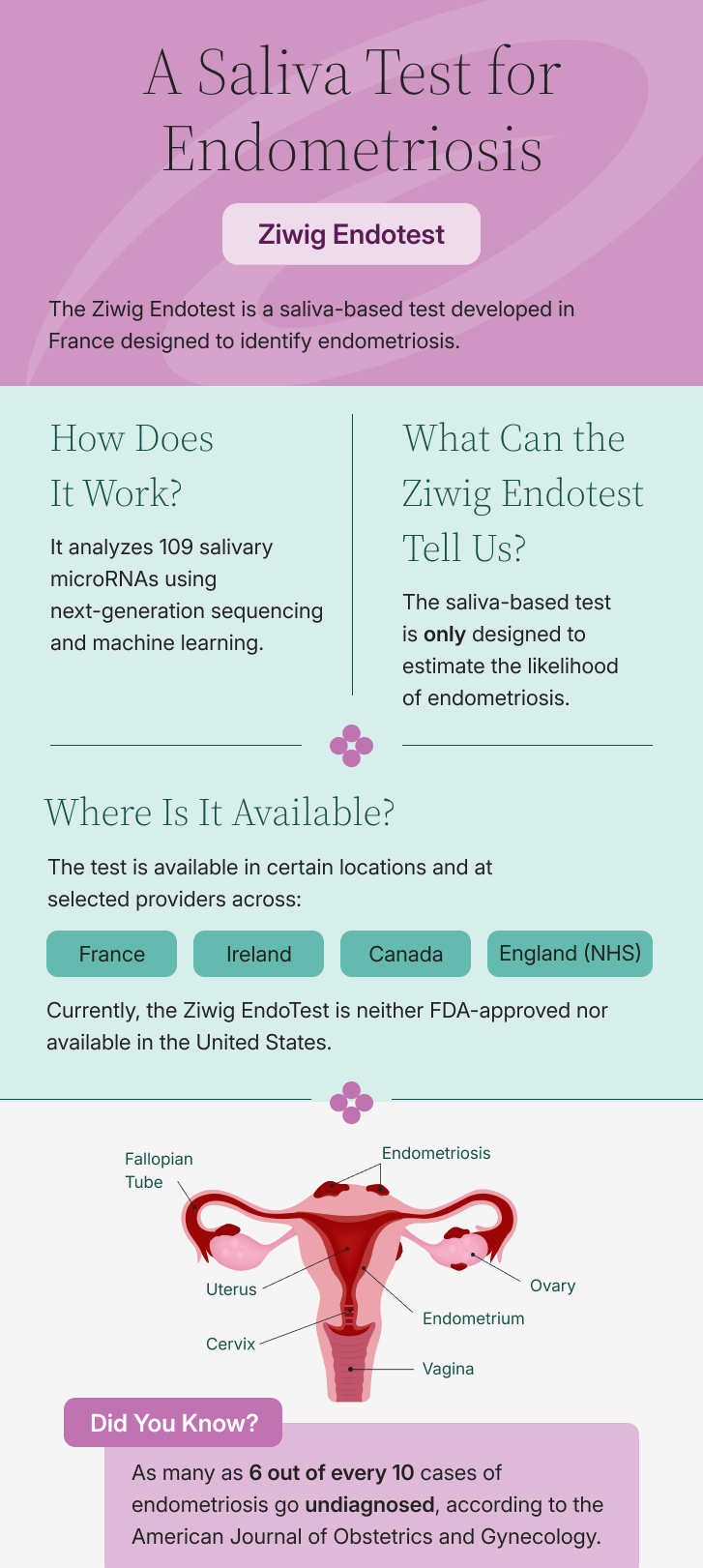
The Ziwig Endotest is a new, non-invasive saliva test that can diagnose endometriosis. It works by analyzing 109 salivary microRNAs using next-generation sequencing and machine learning. While the test is available across parts of Europe, it isn’t yet available in the United States.
-
Ziwig, the French manufacturer of Endotest, states that its non-invasive saliva-based microRNA assay, in its largest prospective multicenter external validation study (n=971), demonstrated 97.3% sensitivity, 94.1% specificity, and 96.6% overall diagnostic accuracy for endometriosis.
-
In the U.S., endometriosis affects 1 in 10 women of reproductive age. Endometriosis can cause symptoms such as severe pelvic pain, heavy periods, infertility, and even incontinence.

Endometriosis affects an estimated 200 million women worldwide, yet recent research shows that a diagnosis can take up to 10 years.
A new non-invasive saliva test for endometriosis, the Ziwig Endotest, may change that. Learn what experts are saying.
What Is Endometriosis?
Endometriosis is a chronic inflammatory disease. Tissue similar to the lining of the uterus grows outside the uterus, spreading in and around regions such as the bladder, cervix, rectum, and intestines.
In some rare cases, endometriosis has even been found in the lungs.
Board-certified physician assistant Aleece Fosnight, who runs the Fosnight Center for Sexual Health, advocates for people with endometriosis, stating that “so many patients spend years being told nothing is wrong. A real burden of anxiety and depression is layered on top of the physical disease.”
How is Endometriosis Currently Diagnosed?
Receiving a diagnosis for endometriosis can be notoriously difficult, and research suggests that up to 60% of endometriosis cases go undiagnosed.
Doctors generally evaluate a patient for endometriosis by:
-
Reviewing a patient’s symptoms and medical history
-
Performing a physical examination
-
Using imaging tests such as a transvaginal ultrasound or magnetic resonance imaging (MRI)
Where is the Test Available?
The Ziwig Endotest is available in several countries across parts of:
-
Europe, such as:
-
France, Ireland, and the United Kingdom.
-
-
The Middle East, such as:
-
Turkey, Iraq, and Saudi Arabia.
-
-
The Americas, including:
-
Canada, Brazil, and Uruguay.
-
-
Asia, including:
-
India, Singapore, and Malaysia.
-
The test's availability depends on where a patient lives, whether a clinician can order it, and how the test is covered.
On July 7, 2026, the National Institute for Health and Care Excellence (NICE) announced guidance that allowed the National Health Service (NHS) to use the test during a three-year evidence-gathering period.
However, in the United States, the Ziwig Endotest has not been FDA-cleared, and patients cannot access it.
How Does the Endometriosis Saliva Test Work?
According to Ziwig, the Endotest is an in vitro diagnostic medical device. It’s designed to detect endometriosis using a saliva sample.
The test is made for patients between the ages of 18 and 43 with symptoms that are “indicative of endometriosis,” such as pelvic pain, painful periods (dysmenorrhea), painful bowel movements, pain during intercourse, or unexplained infertility.
It arrives in a collection kit with instructions. You provide your saliva sample, seal the box, and send the test to Ziwig’s Central Laboratory for analysis.
When Will the Ziwig Endotest Reach the United States?
While the Ziwig Endotest may help prevent the years-long wait many patients are often expected to endure, it still isn’t accessible in the United States. There’s also no clear public timeline for FDA clearance.
Currently, doctors diagnose endometriosis through a physical exam and imaging tests.
Only recently did the American College of Obstetricians & Gynecologists (ACOG) formally recommend making a working diagnosis and starting treatment without first requiring laparoscopic surgery to confirm the disease.
To Fosnight, the change is especially significant: “For years, the requirement of surgical confirmation was itself one of the biggest drivers of delay. Removing that requirement has been one of the most patient-centered changes in this field in a generation.”
For now, another question remains: if a noninvasive endometriosis test is helping patients in other countries get answers sooner, when will U.S. women have the same opportunity?
Frequently Asked Questions
Is an endometriosis saliva test available in the United States?
No, there aren’t any FDA-cleared saliva tests or spit tests designed to diagnose endometriosis in the United States.
Where was the Ziwig endometriosis spit test first tested?
The Ziwig Endotest was first tested in France across a total of 971 symptomatic women ages 18 to 43.
What is the difference between the Ziwig Endotest and Endosure?
The Ziwig Endotest is a diagnostic test that analyzes a saliva sample using next-generation sequencing and artificial intelligence to look for microRNA markers linked to endometriosis. EndoSure is a separate test developed by ENDOSURE, INC. that uses sensor pads on the abdomen to measure electrical signals in the gut.
What else is endometriosis known as?
Endometriosis is also known as “endo.”
What are the most common symptoms or signs of endometriosis?
The most common symptoms of endometriosis include chronic pelvic pain, painful periods, heavy bleeding during periods, pain during or after sex (dyspareunia), difficulty getting pregnant, pain during urination, constipation, urinary incontinence, bloating, and painful bowel movements (which may be a result of bowel endometriosis).
Who do I see if I suspect I may have endometriosis?
If you think you may have endometriosis, schedule an appointment with your doctor. They’ll begin by asking you about your symptoms and may give you a physical exam. Your doctor can also refer you to an endometriosis specialist or a gynecologist (OB-GYN).
Aleece Fosnight
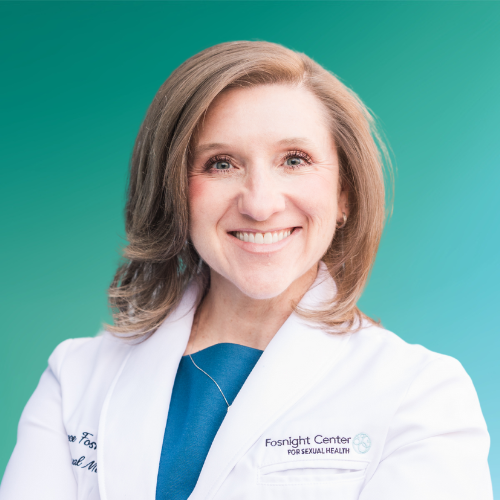
Aleece Fosnight, MSPAS, PA-C, CSC-S, CSE, NCMP, IF, HAES is a board-certified physician assistant specializing in sexual medicine, women’s health, and urology.
In 2019, Fosnight opened up her own private practice, the Fosnight Center for Sexual Health, and implemented the sexual health grand rounds curriculum at her local hospital and residency program.
Fosnight is also the founder of the Fosnight Foundation, a non-profit organization dedicated to the education and training of professionals in the sexual health field and providing funding for access to healthcare services in her local community.
About the Author
Tiff Perritt is the Content Writer at Aeroflow Urology. She writes with clarity and compassion on topics surrounding incontinence, aiming to help patients feel informed and supported. Driven by a strong interest in health equity, she supports efforts that promote education and access to incontinence care for underserved communities.
She earned her Bachelor's degree in Technical Communications from University of Houston - Downtown and her Associate's degree in English from Lee College. Her work has been featured by leading healthcare colleges and respected healthcare organizations across the country.
Outside of work, she loves to hike across the Texas landscape, try out new baking recipes, and spend time with her family.
References
American College of Obstetricians and Gynecologists’ Committee on Clinical Practice Guidelines–Gynecology. Diagnosis of Endometriosis: ACOG Clinical Practice Guideline No. 11. Obstetrics & Gynecology. 2026;147(3):432–448.
De Corte, P., Klinghardt, M., von Stockum, S., & Heinemann, K. (2024, October 7). Time to diagnose endometriosis: Current status, challenges and regional characteristics—A systematic literature review. BJOG: An International Journal of Obstetrics & Gynaecology, 132(2), 118–130.
Endometriosis Foundation of America. (n.d.). Endometriosis: Defining it, recognizing it, and treating it.
Fryer, J., Mason-Jones, A. J., & Woodward, A. (2024, October 17). Understanding diagnostic delay for endometriosis: A scoping review using the social-ecological framework. Health Care for Women International, 46(3), 335–351.
National Institute for Health and Care Excellence. (2026, July 7). New technologies could help cut years-long wait for endometriosis diagnosis.
Yao, J., Zheng, H., Nie, H., Li, C. F., Zhang, W., & Wang, J. J. (2023). Endometriosis of the lung: A case report and review of literature. World Journal of Clinical Cases, 11(18), 4326–4333.
Ziwig. (n.d.). Ziwig Endotest®: A saliva test for endometriosis.
Ziwig. (2025, December 2). Ziwig Endotest®: Scientific validation published in NEJM Evidence. PR Newswire.