What Is a Letter of Medical Necessity, and When Do You Need One?
-
 By
Tiff Perritt
Key Takeaways:
-
A letter of medical necessity (LMN) is a document from a licensed healthcare provider that recommends and explains why a specific product, treatment, or service is considered medically necessary.
-
An effective LMN should be detailed and include your specific diagnosis, relevant ICD-10 codes, treatment details, why the items or services are needed, and any supporting medical records or documents.
-
You may need an LMN if you need certain expenses covered or reimbursed through insurance, a flexible spending account (FSA), a health savings account (HSA), or a health reimbursement arrangement (HRA).

Health insurance can cover many types of care, but it doesn’t pay for everything.
Certain items — such as vitamins and incontinence supplies, or services like nutrition counseling and physical therapy — may require a letter of medical necessity.
An LMN explains why your healthcare provider recommends a specific product, treatment, or service for a medical reason rather than personal use. You may also need one for certain FSA, HRA, or HSA expenses to show that the expense qualifies as medical care under IRS rules.
When Do You Need a Letter of Medical Necessity?
Before requesting a letter of medical necessity, check whether the item, service, or treatment is already covered under your health insurance plan. You generally need an LMN only when additional documentation is required.
Below are some common reasons when you may or may not need a letter of medical necessity:
| Criteria | Standard Coverage (No LMN Needed) | LMN (Letter of Medical Necessity) Required |
|---|---|---|
| When | Routine care, treatments, or items already covered by your insurance plan. | Dual-purpose supplies (health vs. general wellness), non-formulary / specialty supplies, or out-of-network services. |
| Common Examples | - Annual wellness physicals - Standard prescriptions - Routine diagnostic lab work |
- Specialized supplies - Durable medical equipment (e.g., custom wheelchairs) - Non-standard medications or treatments |
| Applies To | Health Insurance, including Medicaid | Health Insurance, Medicaid, FSA, HSA, or HRA |
| Why | When your coverage is outlined through your standard health insurance benefits | Helps support coverage, an exception, or reimbursement |
How Can I Get a Letter of Medical Necessity?
If you need an LMN, contact your doctor, specialist, or other healthcare provider. Your provider can write a detailed letter explaining why a treatment, service, or item is medically necessary for your condition.
Did You Know? Some durable medical equipment suppliers, like Aeroflow Urology, can obtain an LMN from your doctor. You’ll only need to confirm that the supplies you need are medically necessary.
We help kids and adults get $0 incontinence supplies like diapers, pull-ons, or bladder control pads through insurance. Find out if you qualify for insurance-covered supplies.
What Should a Letter of Medical Necessity Include?
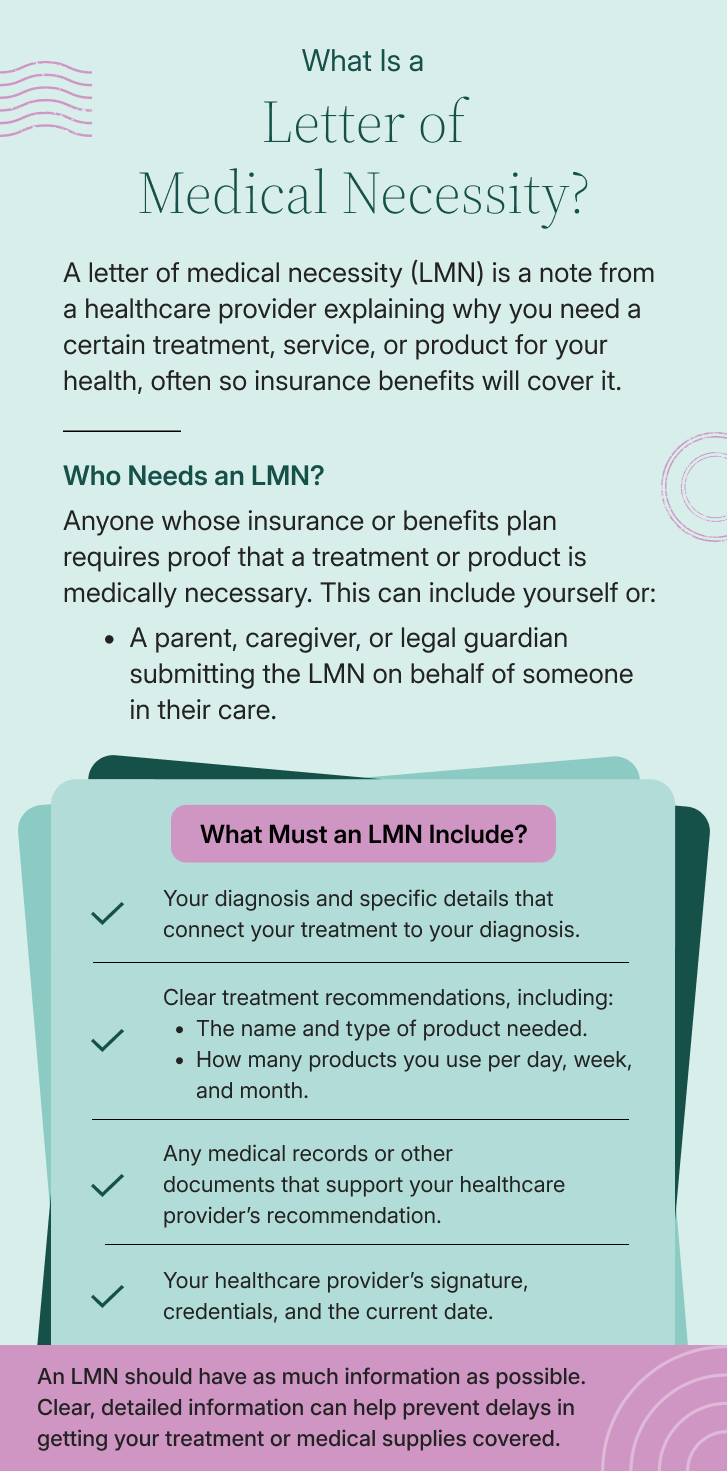
An LMN should include enough information to prove why a specific treatment, service, product, or piece of equipment is medically necessary for your condition.
Take a look at the following information that you’ll need in a letter of medical necessity:
Relevant Insurance Information
Make sure that an LMN always includes your:
-
Name
-
Date of birth
-
Member ID number
-
Group number (also known as a policy number)
Your Specific Diagnosis
Your diagnosis should be clearly outlined in the letter and include any associated symptoms or limitations. This helps show why the recommendation is medically necessary.
Details About the Provider’s Recommendation
This portion of the LMN should describe your provider's recommendation and include key details. Its aim is to connect your diagnosis with the “why.” The more detail, the better.
This may include:
-
The name and type of treatment, service, equipment, or supplies you or the person you’re caring for, such as your child, parent, or spouse
-
Length of time you’re expected to need the services, treatments, or products
-
How often you need a service, such as physical therapy, speech therapy, or a medically necessary gym program
-
How many supplies you need per day, week, or month, such as bladder control supplies or diabetes supplies
-
Details about medical equipment, including durable medical equipment, such as a wheelchair, walker, or other device your provider recommends
Note: Make sure your provider includes a start and end date for their recommendations in the letter of medical necessity.
Supporting Medical Records and Documentation
Your doctor should include medical records or other medical documents that support their recommendation.
This can include information such as:
-
Evaluations
-
Test results
-
Specialist notes
-
Treatment notes
-
Prescription history
-
Hospital or discharge records
-
Imaging results, such as X-rays or MRIs
-
Records of other treatments you’ve tried
Your Healthcare Provider’s Information
The LMN should also contain your provider’s name, credentials, contact information, and their signature.
What Does a Letter of Medical Necessity Look Like?
While a letter of medical necessity doesn’t have to follow a specific format, it must include specific details.
An LMN can also look slightly different depending on your insurance plan, your licensed healthcare provider, and what type of product, treatment, or service you need.
Take a look at an example of what an LMN might look like before you and your licensed medical provider fill in the information in the brackets:
[Date]
[Name of insurance company]
[Address]
Insured Patient Name: [Patient name]
DOB: [Patient DOB]
Member ID: [Member ID number]
Group Number: [Group number or policy number]
Dear [insert appropriate contact name or department]:
I am treating [patient name] for [diagnosed medical condition]. I am recommending [specific treatment, product, or service] to treat this condition.
[Add a detailed explanation that outlines how the recommended treatment, product, or service will help improve the patient’s diagnosed condition].
This treatment is medically necessary from [start date] through [end date].
Sincerely,
[Healthcare professional’s name and credentials]
[Healthcare professional’s provider number]
[Contact information]
[Signature]
Note: Fill out only your personal and insurance information on an LMN. Contact the healthcare provider who filled out your LMN if it is missing information or has errors.
Reasons Why Your Letter of Medical Necessity May Be Denied
Sometimes, a letter of medical necessity may lead to a rejection of your claim for coverage.
An LMN-related denial can happen for several reasons, such as:
-
The requested treatment, service, supplies, or equipment isn’t covered under the patient’s plan.
-
The requested treatment, service, or equipment is not available through an in-network provider, facility, or supplier.
-
The request doesn’t meet the plan's coverage rules or doesn’t clearly indicate the patient’s diagnosis or limitations to prove medical necessity.
-
The requested dates, number of visits, amount of supplies, or length of treatment don’t match what the insurance plan allows.
It may also be rejected because of incorrect or absent documentation.
According to KFF, 25% of in-network claim denials for people enrolled in Affordable Care Act (ACA) plans in 2024 were due to administrative reasons, such as missing information or late submissions.
Note: This is not a complete list of reasons a letter of medical necessity may be denied. If you are trying to appeal an LMN denial, contact your insurance provider to find out why the request was denied.
Check your coverage for $0 medical supplies like diapers or pull-ons for kids and adults!
Frequently Asked Questions
How can you get a letter of medical necessity?
If you need an LMN, contact your doctor, specialist, or other healthcare provider. Your provider can write a detailed letter that clearly states why a treatment, service, or item is medically necessary for your condition. You then send the LMN to your health insurance provider.
Who can write a letter of medical necessity?
A letter of medical necessity must be written or signed by a licensed healthcare provider who has evaluated your condition. This can include a doctor, nurse practitioner, physician assistant, or another qualified provider.
How long is a letter of medical necessity good for?
The amount of time a letter of medical necessity is valid varies. However, most LMNs are only valid for up to one year. Make sure the provider who completes your LMN provides a time range for how long the letter is valid.
Can you get a letter of medical necessity for a gym membership?
Yes, in some cases. A healthcare provider may write an LMN for a gym membership if exercise is needed to treat or manage a medical condition. However, whether the gym membership is covered depends on your insurance plan.
Can I write my own letter of medical necessity?
No, you cannot write your own letter of medical necessity. An LMN must be signed by a licensed healthcare provider who has taken the time to evaluate your condition.
Do you need a letter of medical necessity for diapers?
Generally, you'll need a letter of medical necessity if you want insurance, Medicaid, or a health savings account to pay for diapers. Check whether you’re covered for free diapers through insurance or Medicaid.
What’s the difference between an LMN and an LOMN?
Both an LMN and a LOMN refer to a letter of medical necessity. These abbreviations are sometimes used interchangeably.
Mica Phillips

Mica has been at Aeroflow for over ten years. He brings creativity to a sometimes stagnant and complacent industry and tries his best to uncomplicate the complex world of Insurance. He is a graduate of the University of North Carolina and holds a Bachelor’s degree in English. In addition to his daily responsibilities as Executive Vice President of Aeroflow Urology, he’s contributed to numerous articles for online journals regarding senior care, incontinence, and navigating insurance benefits. In his spare time, he enjoys listening to live music, visiting breweries, and traveling the world with his wife and daughter.
About the Author
Tiff Perritt is the Content Writer at Aeroflow Urology. She writes with clarity and compassion on topics surrounding incontinence, aiming to help patients feel informed and supported. Driven by a strong interest in health equity, she supports efforts that promote education and access to incontinence care for underserved communities.
She earned her Bachelor's degree in Technical Communications from University of Houston - Downtown and her Associate's degree in English from Lee College. Her work has been featured by leading healthcare colleges and respected healthcare organizations across the country.
Outside of work, she loves to hike across the Texas landscape, try out new baking recipes, and spend time with her family.
References
Internal Revenue Service. (2025). Publication 502 (2025), Medical and dental expenses.
Long, M., Lo, J., & Pestaina, K. (2026, March 24). Claims denials and appeals in ACA Marketplace plans in 2024. KFF.