
Medicaid Work Requirements
Medicaid Work Requirements Explained


This content has been reviewed for accuracy by Mica Phillips, Vice President of Aeroflow Urology.
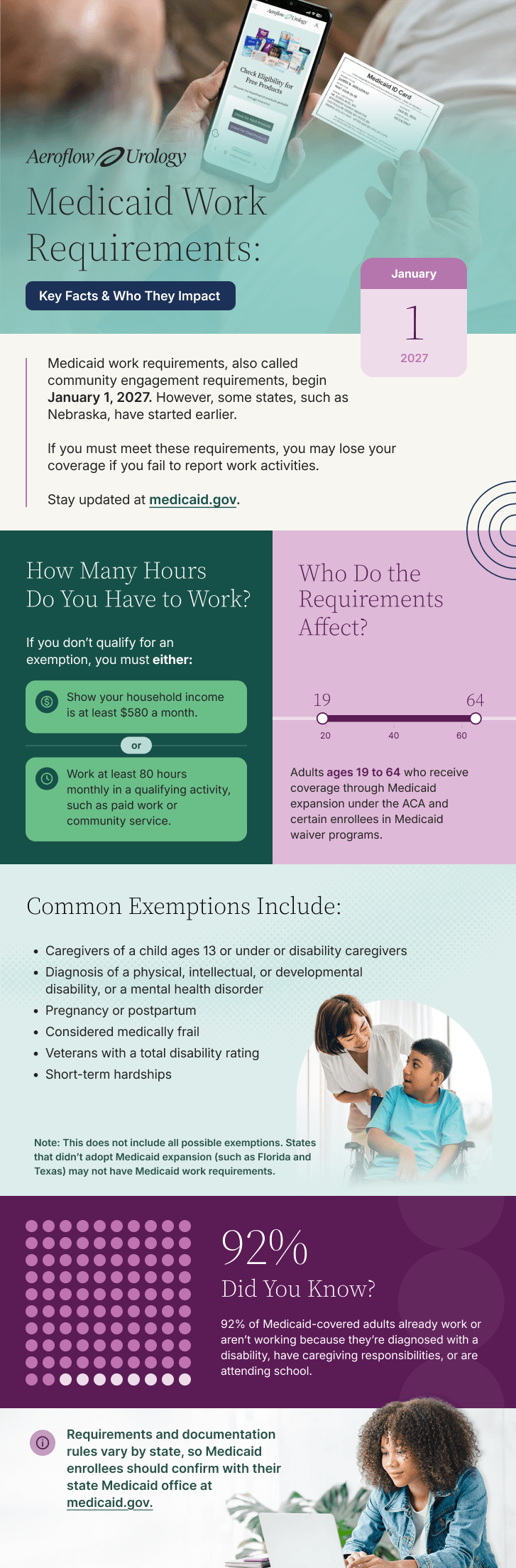
Beginning on January 1, 2027, adults ages 19 to 64 who receive coverage through Medicaid expansion under the Affordable Care Act (ACA) and certain enrollees in Section 1115 Medicaid waiver programs must meet Medicaid work requirements, unless they qualify for an exemption.
If you aren’t exempt, you must show proof that you are working, participating in a job-training program, in school, or volunteering. Learn about these requirements and whether you qualify for an exemption to protect your coverage.
Requirements and documentation rules vary by state, so Medicaid enrollees should confirm with their state Medicaid office before making any coverage decisions.

Not Sure if You’re Exempt From New Requirements?
Take our quiz to find out if you qualify for an exemption from Medicaid work requirements.
Find My State Medicaid Work Requirements Guidelines
Select your state below to learn more about its coverage requirements.
Note: The following states did not adopt Medicaid expansion, which means that Medicaid work requirements may not apply in these states:
-
Alabama
-
Florida
-
Georgia*
-
Kansas
-
Mississippi
-
South Carolina
-
Tennessee*
-
Texas
-
Wisconsin*
-
Wyoming
* While these states did not adopt Medicaid expansion, they may still impose work requirements through waivers or broad federal legislation.
Georgia launched Georgia Pathways to Coverage in July 2023. The limited Medicaid program requires some adults to complete at least 80 hours a month of work, school, job training, volunteering, or another approved activity to qualify. This is separate from the new nationwide Medicaid work requirement.
When Do Medicaid Work Requirements Start?
Medicaid work requirements (also called community engagement requirements) for Medicaid recipients who don’t qualify for an exemption begin nationwide on January 1, 2027. However, some states have started before the deadline:
States can also request an extension of the Medicaid work requirements until December 31, 2028, if the state can demonstrate a good-faith effort to meet the requirements.
Understanding Medicaid Work Requirements
Over 65 million Americans rely on Medicaid.
In fact, 92% of Medicaid-covered adults are already working or aren’t working due to caregiving responsibilities, school attendance, or because they’re dealing with an illness or disability.
When H.R. 1, also called the “Big Beautiful Bill,” became law on July 4, 2025, it set new work requirements for some adults on Medicaid.
If these rules apply to you or your loved one, you’ll need to prove each month that you’re meeting these work or community engagement requirements to keep your Medicaid coverage.
Who Do the Medicaid Work Requirements Apply To?
Medicaid work requirements apply to:
-
Some adults ages 19 to 64 who receive Medicaid through Medicaid expansion under the Affordable Care Act, which covers adults with incomes up to 138% of the federal poverty level.
-
Certain adults ages 19 to 64 who are enrolled in certain Medicaid waiver programs, called Section 1115 waivers. The coverage must meet the federal definition of “minimum essential coverage.”
Medicaid work requirements will not apply to you if you qualify for an exemption.
However, even if you qualify for an exemption, if you don’t report it on time, the state can deny or end your coverage, meaning you may become uninsured.
Do You Qualify for an Exemption?
You don’t have to meet Medicaid work requirements if you are:
-
Under the age of 19 or above the age of 64.
-
The parent, guardian, or caregiver of a child aged 13 or under.
-
Caring for a person with a disability.
-
Pregnant or gave birth within the last 12 months (depending on your state).
-
Receiving Supplemental Security Income (SSI), entitled to or enrolled in benefits under Medicare Part A, or enrolled in benefits under Medicare Part B.
-
Diagnosed with a physical, intellectual, or developmental disability, including disabling mental disorders.
-
Medically frail, demonstrating an impaired capacity to meet work requirements.
-
A veteran with a total disability rating.
-
A member of a federally recognized tribe or an individual who is eligible to receive Indian Health Service (IHS).
-
Incarcerated or were recently incarcerated in the last three months.
-
Participating in a qualifying substance use disorder (SUD) treatment program.
-
Already meeting work requirements through programs including Temporary Assistance for Needy Families (TANF) or the Supplemental Nutrition Assistance Program (SNAP).
-
Currently a foster youth or former foster youth under the age of 26.
-
Facing a short-term hardship, such as:
-
Receiving care in a hospital, nursing facility, psychiatric facility, or other intensive care settings.
-
Part of a federally declared disaster area.
-
Living in a county with an unemployment rate higher than 8%.
-
Required (either you or your dependents) to travel outside of your home for medical care for an extended time.
-
Note: Your state Medicaid agency follows federal rules to determine if Medicaid work requirements apply to you. However, some exemptions can vary by state. Always check with your state Medicaid agency to confirm which exemptions apply to you or not.
Did You Know? Our short quiz can help you find out if you may qualify for an exemption from Medicaid work requirements.
How Many Hours Do You Have to Work?
If you do not qualify for an exemption under the work requirements for Medicaid, you must either:
-
Show that your household income is at least $580 a month.
-
Work at least 80 hours each month in one or more qualifying activities, such as paid work, half-time enrollment in a higher education program, or community service.
If you already have Medicaid, you’ll have to show you met the requirement at least once at renewal. Renewals for adults under Medicaid expansion happen every 6 months starting in January 2027, and some states may check more often.
What Counts Toward the Medicaid Work Requirement?
To ensure you’re following the Medicaid work requirement, you can meet one (or a combination) of these options:
-
Paid employment: Working at least 80 hours per month in any paid job.
-
Minimum wage equivalent: Earning at least $580 per month (the equivalent of 80 hours at the federal minimum wage of $7.25), including through self-employment or business income.
-
Seasonal work: Having an average monthly income over the last six months of at least $580.
-
Work program: Completing 80 hours per month in an approved work program or job training.
-
Community service: Completing at least 80 hours per month of community service activities, such as volunteering.
-
Education: Enrolling in an educational program at least half-time at an institution of higher education, a career or technical education program, a high school, or high school equivalency program.
Note: If you fail to respond to your state Medicaid office that you qualify for an exemption from Medicaid work requirements within 30 days, you could lose your Medicaid coverage. This is also called disenrollment.
Keep your Medicaid coverage updated by contacting your state Medicaid office.
What Do These Changes Mean for Medicaid Enrollees?
For many people, the biggest change is more paperwork, as you may have to prove and report your work or approved activities on time to keep coverage. Even if you’re exempt, missing a form or deadline could still put your Medicaid at risk.
This could mean:
-
More reporting and check-ins with your state Medicaid agency.
-
Higher risk of disenrollment if forms are late or incomplete.
-
Coverage gaps that could leave you uninsured.
You should be aware that if you or your loved one receives Medicaid and fails to fill out the correct forms or doesn’t report a change, you may lose access to insurance, including any medications or supplies.
If you rely on these benefits, it’s important to stay up to date on policy changes and check your coverage.
Have Medicaid Work Requirements Existed Before?
Yes, some states have previously implemented Medicaid work requirements.
In June 2018, Arkansas became the first state to require adults receiving Medicaid to meet work requirements.
When the policy was halted in 2019, 18,000 adults lost coverage. A study also found that 70% of recipients said they felt “confused” about reporting requirements.
What to Do if You’re on Medicaid
The Congressional Budget Office (CBO) estimates that 4.8 million people will lose coverage nationwide by 2034 due to Medicaid work requirements.
However, while Medicaid may be changing, there are a few things you can do to reduce the chance of losing your coverage. Here’s how:
-
Keep your personal contact information and work status up to date with your local Medicaid office. If work requirements apply to you, begin planning now.
-
Stay informed about policy changes to your state’s Medicaid program, especially if you rely on regular deliveries of supplies, like free diapers through Medicaid.
-
Contact your state Medicaid agency to check on your enrollment status and requirements. You can also check your physical mail and email (including your spam folder) for any communication from your Medicaid provider. Also, stay in contact with your insurance, and report any change, such as your household income, between now and January 1, 2027.
Frequently Asked Questions
Are there work requirements for Medicaid?
Yes, starting January 1, 2027, if you are between the ages of 19 and 64 and receive Medicaid through Medicaid expansion under the Affordable Care Act or certain Medicaid waiver programs, you must meet these requirements unless you qualify for an exemption.
Who is exempt from Medicaid work requirements?
You may be exempt from Medicaid work requirements if you meet certain conditions, such as being the caregiver of a child 13 or younger; being pregnant or recently postpartum; or having a diagnosed health condition or disability. Our free quiz can help you see if you qualify for an exemption.
Do you have to work to get Medicaid?
If you don’t qualify for an exemption, yes. By January 1, 2027, each state must comply with work requirements (if the state has work requirements) unless it files for an extension, which can last through December 31, 2028. Visit your state’s Medicaid website to stay updated on the latest news.
How much do I have to make to meet Medicaid requirements?
If Medicaid work requirements apply to you, you may be able to satisfy this requirement by earning at least $580 a month (equivalent to 80 hours at the federal minimum wage). You can also meet the requirement through qualifying activities, such as volunteering, participating in a work program, or attending school.
I am already meeting work requirements because I have SNAP. What about Medicaid?
SNAP rules don’t automatically carry over to Medicaid. Once your state begins implementing work requirements, you may have to report your work hours separately to keep your Medicaid coverage, even if you already report them for SNAP. Find out more through your state’s Medicaid website.
Will I have to meet Medicaid work requirements?
Only your state Medicaid office will know if you must meet Medicaid work requirements. Our free, six-question quiz can help you find out if you may qualify for an exemption, but it should not be used as legal or Medicaid advice.
Will Medicaid work requirements impact access to bladder control products?
You can lose access to bladder control products if you don’t meet certain Medicaid requirements. However, requirements vary by state. You can stay up to date on Medicaid work requirements by visiting your state’s Medicaid website. If you qualify for Medicaid, you can get free incontinence supplies through your insurance.
Sources
Brownstein, M. (2025, July 29). How Medicaid cuts could lead to loss of coverage for millions. Harvard T.H. Chan School of Public Health.
Center for Health Care Strategies. (2025, December). A Summary of Federal Medicaid Work Requirements.
Centers for Medicare & Medicaid Services. (2024, June). Medicaid Expansion Adult Enrollment [Data set]. Medicaid.gov MAC Scorecard.
Centers for Medicare & Medicaid Services. (2026, October 30). July 2026 Medicaid & CHIP Enrollment Data Highlights. Medicaid.gov.
Sommers, B. D., Chen, L., Blendon, R. J., Orav, E. J., & Epstein, A. M. (2020). Medicaid Work Requirements In Arkansas: Two-Year Impacts On Coverage, Employment, And Affordability Of Care. Health Affairs, 39(9), 1522–1530.
Disclaimer: Requirements and documentation rules vary by state, so Medicaid enrollees should confirm with their state Medicaid office before making any coverage decisions.