PCOS Is Now PMOS: Why 70% of Women Don’t Know They Have It.
-
 By
Tiff Perritt
By
Tiff Perritt
Key Takeaways:
-
On May 12, 2026, polycystic ovary syndrome (PCOS) was renamed to polyendocrine metabolic ovarian syndrome (PMOS).
-
The change to PMOS drops the misleading focus on ovarian cysts and formally recognizes the condition as a multisystem disorder.
-
Experts now warn that the global prevalence of PCOS / PMOS rates among young women and adolescents aged 10-24 is projected to surge nearly 11% by 2036.


Polycystic ovarian syndrome (PCOS), which affects more than 170 million women worldwide, is now polyendocrine metabolic ovarian syndrome (PMOS).
But what drove the change?
New data reveals that the term PCOS is misleading, and has even been shown to delay diagnosis and prevent effective medical care.
The updated term, PMOS, more accurately reflects how the condition is a full-body disorder rather than an isolated ovarian issue.
Yet, with up to 70% of women continuing to go undiagnosed, the name change is only the first step. A global coalition of health leaders is now pushing for urgent research, including the evaluation of potential PMOS subtypes over the next three years.
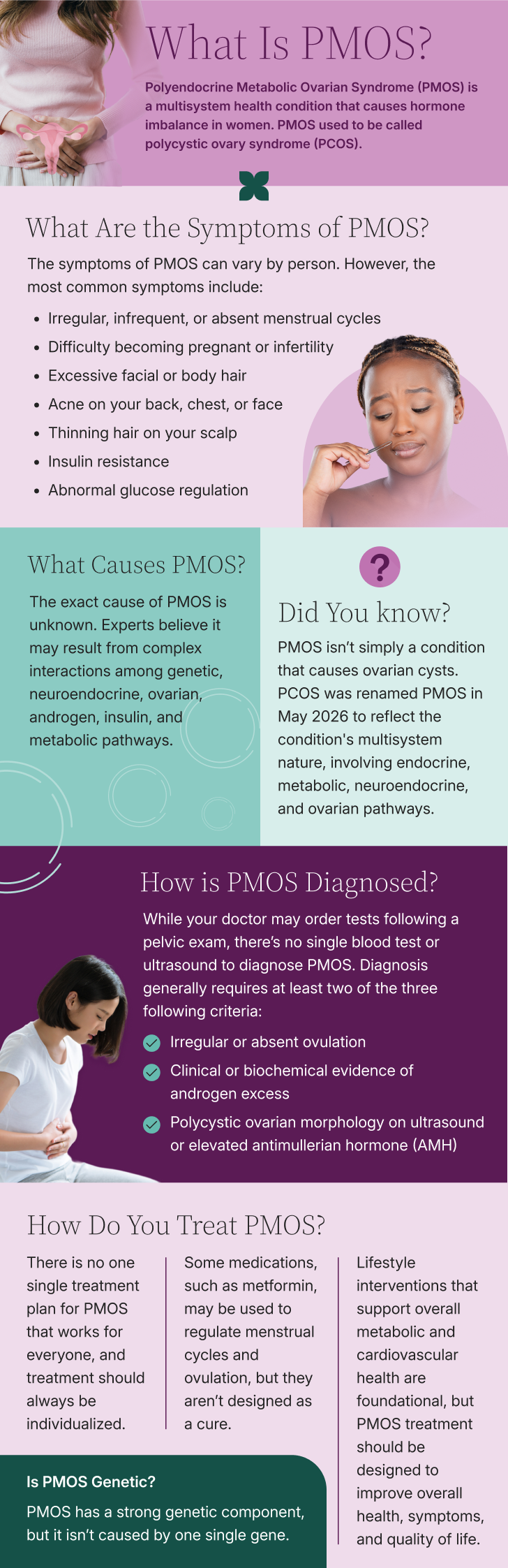
What Is PMOS?
PMOS is a common condition that causes hormonal imbalance.
Until recently, it was referred to as a primarily gynecological or reproductive issue centered on irregular periods, ovarian cysts, and fertility.
“For decades, the term “polycystic ovarian syndrome,” says Aleece Fosnight, medical advisor for Aeroflow Urology, “unintentionally told patients and also clinicians to look primarily at the ovaries.”
However, medical consensus now recognizes PMOS as a complex, multisystem endocrine and metabolic condition, impacting one in eight women.
The disorder is driven largely by insulin resistance.
As a result, it can influence everything from your blood sugar regulation to your daily energy, mood, and long-term heart health — even past your reproductive years.
Symptoms of PMOS
The condition’s impact extends far beyond disjointed menstrual cycles. The most common signs and symptoms of PMOS include:
-
Irregular or absent ovulation
-
Infrequent or absent periods
-
Difficulty becoming pregnant or infertility
-
Excessive facial hair or body hair
-
Acne on your back, chest, or face
-
Thinning hair on your scalp
-
Insulin resistance and abnormal glucose regulation
-
Lower urinary tract symptoms (LUTS), such as incontinence
The condition can also be associated with significant mental health concerns, such as depression, anxiety, disordered eating, and a reduced quality of life.
Did You Know? It’s possible to have PMOS and not have any symptoms.
What Causes PMOS?
Is there a primary, leading cause?
Medical experts say there isn’t.
Though, Fosnight states that research points to a “complex interaction among genetic, neuroendocrine, ovarian, androgen, insulin, and metabolic pathways. These pathways can reinforce one another,” relays Fosnight.
Why Was PCOS Renamed to PMOS?
According to an international expert consensus published in The Lancet in May 2026, the term “PCOS” is now considered a “misnomer,” its previous name deemed “inaccurate and misleading.”
Historically, the term PCOS only reflected one organ, the ovaries, and failed to address the condition's multisystem endocrine and metabolic features.
“Polyendocrine metabolic ovarian syndrome,” says Fosnight, “now more accurately reflects what we understand about the condition today. It also removes the misleading implication that some must have an ovarian cyst.”
An Alarming Pattern of Women Going Undiagnosed
The now-retired terminology served to reinforce the misconception that PMOS was merely a reproductive issue, which led to jarring medical consequences.
Fosnight recounts, “Some patients were even told that they were the ones who caused this condition.”
Though, receiving a diagnosis for the condition hasn’t always been easy. The current criteria may involve your doctor ordering a series of tests following a pelvic exam.
There’s still no single blood test or ultrasound to definitively diagnose PMOS, either. This is because diagnosis generally requires you to meet at least two of the following criteria:
-
Irregular or absent ovulation
-
Clinical or biochemical evidence of androgen excess
-
Polycystic ovarian morphology on ultrasound or elevated antimullerian hormone (AMH)
The Name Change May Help Discover New Treatments
Globally, 170 million women live with PMOS.
Put into perspective, the total number of women affected by the condition worldwide is nearly equal to the entire U.S. female population.
To see if the shift from PCOS to PMOS has been a helpful change in the medical community, we sought Fosnight’s insights.
She remarked, “Absolutely! It was a meaningful and much-needed change, although too early to measure its full impact. Despite its prevalence, it remains significantly underdiagnosed, which is why the name change was incredibly important in recognizing symptoms, validating patient concerns, and diagnosing more individuals.”
 PMOS Myths PMOS Myths |
 What’s Really Happening What’s Really Happening |
|---|---|
| “You have to have cysts on your ovaries to have PMOS.” | No, you can have PMOS with zero cysts. |
| “The condition just means you have painful periods.” | False, PMOS is a whole-body health issue. |
| “As you get older, it goes away.” | PMOS is a lifelong condition that can affect you even after menopause. |
| “Women with PMOS can’t get pregnant.” | Not true; polyendocrine metabolic ovarian syndrome can make it harder to conceive, but you can still get pregnant. |
| “Weight loss, by itself, is a treatment option for PMOS.” | Weight loss alone is not a treatment for PMOS, and healthy lifestyle interventions can provide meaningful benefits, even without a change in weight. |
What to Do if You Suspect You Have PMOS
Remember that your pain is valid, and that your concerns deserve to be heard by your doctor.
“The fact that we dismiss and gaslight people’s pain is unacceptable,” says Aleece Fosnight. “PMOS can co-exist with other conditions that cause pelvic pain, including endometriosis, so receiving one diagnosis should not stop the investigation when symptoms do not fit.”
Despite these efforts, the work is far from over.
So, what does the future look like for PMOS diagnosis?
For Fosnight, the terminology marks a significant change: “Perhaps more exciting is what is happening next. The global implementation plan specifically calls for continued evaluation of emerging evidence, including potential PMOS subtypes, with integration of the new International Guideline planned for 2028.”
Check your coverage for $0 incontinence supplies with Medicaid or Insurance now!
Frequently Asked Questions
When did PCOS change to PMOS?
The term PCOS was officially renamed PMOS on May 12, 2026,
Does PMOS have a cure?
No, according to the American Medical Association, polyendocrine metabolic ovarian syndrome (formerly PCOS) does not have a cure. It is a lifelong health condition that can continue beyond a person’s reproductive years.
How do you treat PMOS?
Treatment for PMOS should be individualized around your symptoms, overall health, reproductive goals, and priorities. The goal of treatment should be better metabolic, reproductive, and overall health, not simply a lower number on the scale.
Is weight loss alone a treatment for PMOS?
No, weight loss alone is not a treatment for PMOS. Treatment should focus on addressing hormonal and metabolic factors, including insulin resistance when present, while supporting cardiovascular health and quality of life.
Are there medications that treat PMOS?
Yes, but medications only manage the symptoms of PMOS rather than cure it. Combined hormonal birth control pills can help with irregular menstrual cycles and reduce androgen-related symptoms like hirsutism. Your doctor may prescribe metformin for PMOS, which targets insulin resistance. Anti-androgens (like spironolactone) can help control excess hair growth.
Can PMOS cause infertility?
Yes, polyendocrine metabolic ovarian syndrome is a leading cause of fertility challenges. This is because irregular hormone levels can prevent your ovaries from releasing eggs regularly. However, a diagnosis doesn’t mean that you’re unable to get pregnant.
Is PMOS genetic?
While there is a strong genetic component, PMOS isn’t caused by a single gene. Instead, current evidence supports that multiple genes interact to affect your hormones, metabolism, and reproductive health. Genetics makes up only part of the picture.
I think I have PMOS. What should I do?
If you believe you have PMOS, the first step is to visit a healthcare provider. They’ll be able to listen to your concerns, review your symptoms, and determine if you have PMOS. Before visiting your healthcare provider, track your daily physical symptoms and jot down any questions you want answered.
Aleece Fosnight

Aleece Fosnight, MSPAS, PA-C, CSC-S, CSE, NCMP, IF, HAES is a board-certified physician assistant specializing in sexual medicine, women’s health, and urology.
In 2019, Fosnight opened up her own private practice, the Fosnight Center for Sexual Health, and implemented the sexual health grand rounds curriculum at her local hospital and residency program.
Fosnight is also the founder of the Fosnight Foundation, a non-profit organization dedicated to the education and training of professionals in the sexual health field and providing funding for access to healthcare services in her local community.
About the Author
Tiff Perritt is the Content Writer at Aeroflow Urology. She writes with clarity and compassion on topics surrounding incontinence, aiming to help patients feel informed and supported. Driven by a strong interest in health equity, she supports efforts that promote education and access to incontinence care for underserved communities.
She earned her Bachelor's degree in Technical Communications from University of Houston - Downtown and her Associate's degree in English from Lee College. Her work has been featured by leading healthcare colleges and respected healthcare organizations across the country.
Outside of work, she loves to hike across the Texas landscape, try out new baking recipes, and spend time with her family.
References
Berg, S. (2026, July 8). What doctors want patients to know about PMOS. American Medical Association.
Endocrine Society. (2026, May 12). PCOS name change.
Kölükçü, E., Gülücü, S., & Erdemir, F. (2023, May 15). Association between lower urinary tract symptoms and polycystic ovary syndrome. Revista da Associacao Medica Brasileira (1992), 69(5), e20221561.
Teede, H. J., Khomami, M. B., Morman, R., & Global Name Change Consortium. (2026, June 6). Polyendocrine metabolic ovarian syndrome, the new name for polycystic ovary syndrome: A multistep global consensus process. The Lancet, 407(10545), 2329–2339.
U.S. Census Bureau (n.d.) QuickFacts: United States.
Wang, J., Wang, B., Li, C., Meng, T., Liu, C., Chen, J., & Guo, Y. (2025, May 12). Evolving global trends in PCOS burden: a three-decade analysis (1990-2021) with projections to 2036 among adolescents and young adults. Frontiers in endocrinology, 16, 1569694.