Family Caregiving Comes at a Cost: Your Career or Your Loved One?
-
 By
Tiff Perritt
By
Tiff Perritt
Key Takeaways:
- “Holding a stable job and being a caregiver is very difficult,” said one of the many Americans we heard from in our 2026 Caregivers in Crisis survey.
- For a staggering number of family caregivers, keeping their loved ones safe can sometimes mean missing a paycheck or quitting their job entirely.
- 77% of family caregivers enrolled in Medicaid say they also depend on government assistance programs such as food stamps and Social Security Income (SSI) just to make ends meet, all while cuts to these programs loom.


If you’re balancing work and caregiving, you aren’t alone. We asked over 1,100 U.S. family caregivers, "Have your caregiving responsibilities affected your ability to work or earn income?”
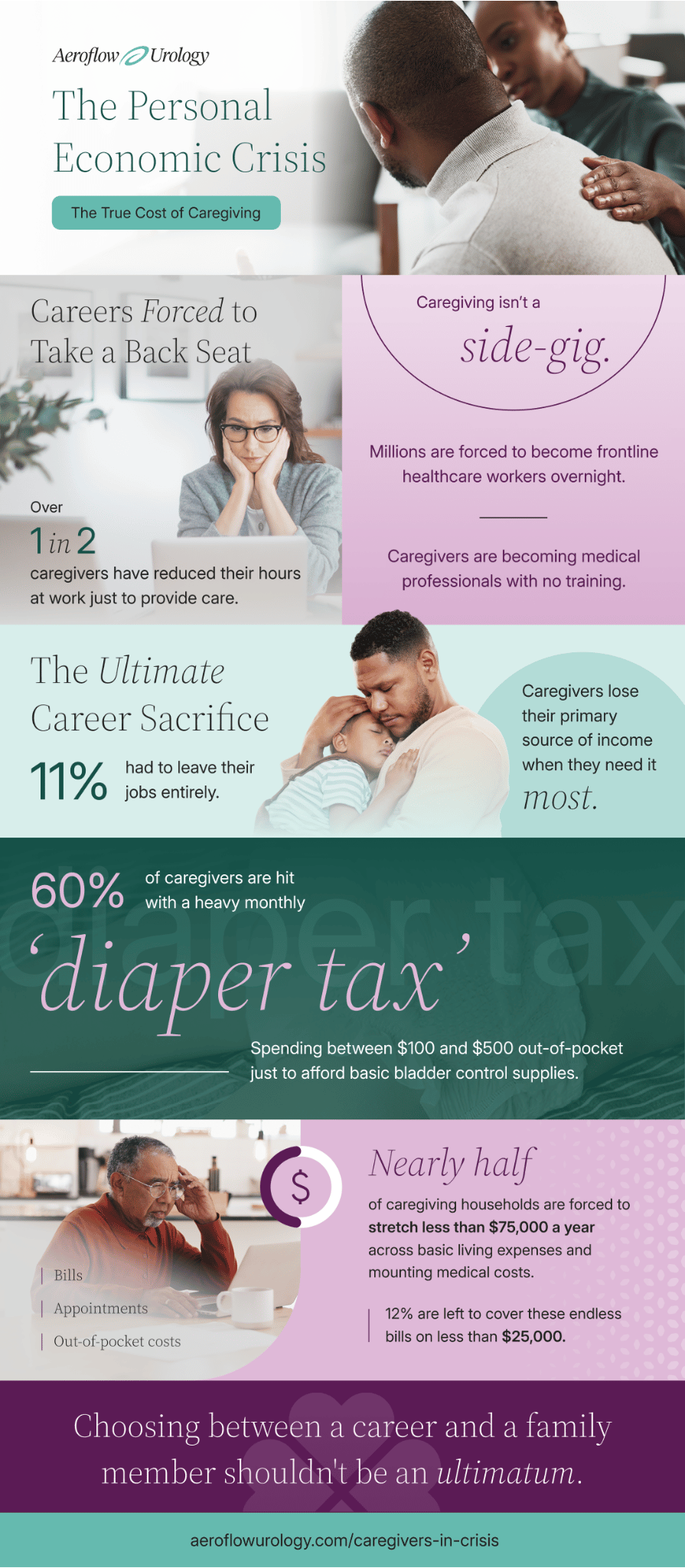
More than half of those surveyed (57%) said they had to reduce their hours at work, while 11% said they were forced to quit completely. For many, making the difficult decision to cut back on working hours or even leave their role doesn’t feel like a real choice, but rather an unexpected sacrifice.
“It’s a full-time job with perpetual overtime,” says one family caregiver.
Supporting a loved one also isn’t an unfamiliar or distant reality for Americans. At some point in our lives, we may become caregivers, whether a spouse needs help recovering after a surgery, a parent falls, or when a child is born with a disability and needs care into adulthood.
As the number of family caregivers continues to rise across the country, we have to ask why so many families are left without any option but to take on this demanding role. Most importantly, what can be done to solve this growing crisis?
This article examines what’s driving caregivers to reduce their hours and end their careers. Plus, learn how you can safeguard your job as a caregiver.
Why So Many Americans Are Becoming Caregivers Overnight
“When there's only one person becoming a caregiver, unless they have a lot of money, they can't afford to hire full care. It's hard to work and take care of someone 24/7 and not have resources or help.”
Sometimes, caregiving becomes more demanding than families expect, leaving them pulled between their loved one’s needs and keeping up with the very work their family depends on.
We took a closer look at the primary reason families are quickly stepping into caregiving roles.
Priced Out of Support
For families already stretched thin, home care is getting more expensive.
In fact, the costs of adult day services and nursing homes have outpaced overall inflation across the country. AARP reports that in 2025, the average cost of home care for a loved one sat at about $35 an hour, but has steadily increased to an estimated $38 an hour in 2026.
Respondents from our Caregivers in Crisis survey also stated that skilled care is few and far between, “I help take care of my grandparents in their 90s, as well as my disabled aunt. Having covered help from a professional is near impossible and very difficult to find and acquire.”
Another surprise cost to consider is the price of hygienic supplies, such as bladder control products, mobility aids, and basic medical supplies.
When asked, 1 out of 4 people surveyed said they spend more than $500 a month on caregiving supplies.
Check your coverage for $0 adult diapers, pull-ons for kids, underpads, and more through insurance!
What About Respite Care?
Respite care, a program that provides temporary relief for primary caregivers, can sometimes be an option for caregivers who need time to work, rest, or handle the responsibilities they may have been putting off to prioritize their loved one.
However, respite care isn’t always covered by insurance.
One caregiver, a senior disabled mother who cares for her 42-year-old adult daughter with cerebral palsy, shares her story: “It’s challenging and getting difficult finding good quality care in today’s workforce. Respite care to give me a day off is $250 a day at my nearest Nursing Home. They do not take any insurances. For me to have a vacation, it would cost over $1,000. For 4 days. You want to keep your loved one home, but it can become impossible.”
How to Protect Your Job While Caring for a Loved One
You may not be able to meet every caregiving need perfectly each time, but you can take steps to protect your income.
Start by finding out what your loved one needs each week, whether you can handle those needs timely, and what support you may need before caregiving becomes unmanageable or interferes with your workday.
Plan Your Caregiving Routines
Wherever you are in the process of family caregiving, building a structured routine can take away some stress.
Write down what you’re going to be in charge of, such as medication intake, cooking meals, driving your loved one to appointments, helping them to the restroom, or stocking up on care supplies. A simple daily and weekly routine can help you identify the most urgent parts of your role.
Jotting this information down can also help if you plan on applying for paid support, respite care, or a Medicaid self-directed home care program (where you are paid as a caregiver). Some programs take time to approve, and a clear list can make it easier to explain what your loved one needs.
You may also find it helpful to look for resources and tools for managing your responsibilities. The Caregiver Action Network (CAN) offers resources such as:
-
A caregiver help desk
-
Community events and support groups to meet with other local caregivers
-
Helpful checklists and guides based on your loved one’s health condition(s)
Ask for Help Before You Burn Out
If caregiving is starting to affect your work, sleep, physical, or mental health, it may be a sign that you’re close to experiencing caregiver burnout. Reaching this point can not only be damaging for your health, but it can also put your loved one’s health at risk.
“I think caregiving for my grandma has been stressful, but having other family members that care about her just as much as I do has helped take a lot of the load off me,” said one survey respondent.
If you can, consider asking a sibling or another family member to handle phone calls, see if a friend can bring a meal, or check if a local program can help with rides to appointments.
Check if You Can Become a Paid Family Caregiver
Caregiving can be incredibly meaningful when you’re giving back to the people who mean the most to you in your life, but it can impact your income.
If you need the support, you may be able to receive income for some of the care you already provide, depending on your circumstances. Some Medicaid self-directed care programs, veterans’ benefits, or state programs may allow you to be paid as a family caregiver.
The rules for qualifying vary by state, your family’s income, and your loved one’s caregiving needs. Some programs may also require an assessment, care plan, or approval before payments can begin.
Start by contacting your state Medicaid office, local Area Agency on Aging, or your loved one’s healthcare provider. Ask what programs are available and what paperwork is needed.
Learn more about getting paid as a caregiver for a family member.
| Programs & Services | Primary Benefit | Requirements & Limitations |
|---|---|---|
| Medicaid Self-Directed Care | May allow eligible family caregivers to be paid for providing in-home care. | Varies by state and requires Medicaid eligibility, a care needs assessment, and an approved care plan. |
| FMLA Leave | Can let you take protected, unpaid time off to care for a family member. | Eligibility depends on your employer, work history, and your loved one’s health condition(s). |
| Respite Care | Gives caregivers a short-term break while someone else provides care. | Availability, cost, and coverage vary by state, local programs, insurance, or Medicaid benefits. |
| Durable Medical Equipment | May partially or fully cover the cost of DME, such as wheelchairs, walkers, or incontinence supplies. | Requires a doctor's prescription and coverage through a qualifying insurance plan. |
Resources & Support
Our commitment goes beyond providing bladder control supplies. We launched our Caregivers in Crisis campaign to give caregivers a voice, advocate for policy change, and connect families with the resources they need.
Are you a family caregiver?
We’re here for you. Get support for your loved one by receiving $0 medical-grade supplies, like diapers or underpads, through Medicaid or insurance.

Submit your loved one’s information, call their doctor, select their products, and we'll ship them to you each month.
Are you a healthcare provider?
We’re here to help your patients find the support they need. To do that, we connect them with $0 medical-grade incontinence supplies, such as diapers or underpads, covered by Medicaid or insurance.
Our 2-Step Referral Process:
-
Diagnose & prescribe: If your patient has a medical need for incontinence supplies and is enrolled in a qualifying insurance plan, download our Patient Order Form to prescribe the appropriate products.
-
Connect with Aeroflow Urology: Ask your patient’s caregiver to submit their loved one’s insurance information through our form, and we’ll help determine coverage and next steps.
Frequently Asked Questions
Are there flexible work options for family caregivers?
If your employer supports flexible work, you may be able to adjust your schedule, work remotely, or work part-time. These options may help you with balancing work and caregiving responsibilities while staying employed.
Can I take time off work to care for a family member?
You may be able to take time off to care for a family member. If you qualify, the Family and Medical Leave Act (FMLA) can give you up to 12 weeks of job-protected, unpaid leave to care for a spouse, child, or parent with a serious health condition.
Can I get financial support as a family caregiver?
In some cases, yes, you may qualify for financial support or be paid as a family caregiver through a Medicaid home care program, respite care, veterans' benefits, or local aging services. However, what you can receive depends on your state, your loved one’s needs, and their insurance.
What is respite care?
Respite care is a short-term program that gives caregivers a break. Often used to help with balancing work and family while caregiving, respite can take place at home or in a care facility, and can last a few hours, a full day, or several days a week.
What is respite care for older adults?
Respite care for older adults is short-term care that gives family caregivers time to rest, maintain a work-life balance, and handle responsibilities. It may include help with meals, medicine reminders, or supervision. You can receive services in-home or at out-of-home facilities, like adult day care centers or assisted living communities.
What is respite care for children?
Children’s respite care gives parents and caregivers support when caring for a child with medical, physical, or developmental needs for a short time period. The goal is to provide the child with a safe, enriching environment at home, in a specialized day care center, or through a community care setting.
Does Medicare pay for respite care?
Medicare typically does not cover the cost of respite care. However, it may cover the cost of short-term inpatient respite care in some circumstances.
Does Medicaid cover respite care?
Medicaid may cover the cost of respite care for your loved one. However, coverage depends on the program your loved one qualifies for and their state of residence. To find out about Medicaid-covered respite care, contact your state Medicaid office.
Mica Phillips

Mica has been at Aeroflow for over ten years. He brings creativity to a sometimes stagnant and complacent industry and tries his best to uncomplicate the complex world of Insurance. He is a graduate of the University of North Carolina and holds a Bachelor’s degree in English. In addition to his daily responsibilities as Executive Vice President of Aeroflow Urology, he’s contributed to numerous articles for online journals regarding senior care, incontinence, and navigating insurance benefits. In his spare time, he enjoys listening to live music, visiting breweries, and traveling the world with his wife and daughter.
About the Author
Tiff Perritt is the Content Writer at Aeroflow Urology. She writes with clarity and compassion on topics surrounding incontinence, aiming to help patients feel informed and supported. Driven by a strong interest in health equity, she supports efforts that promote education and access to incontinence care for underserved communities.
She earned her Bachelor's degree in Technical Communications from University of Houston - Downtown and her Associate's degree in English from Lee College. Her work has been featured by leading healthcare colleges and respected healthcare organizations across the country.
Outside of work, she loves to hike across the Texas landscape, try out new baking recipes, and spend time with her family.
Sources
Caregivers in Crisis Survey. 2026 Family Caregivers in Crisis Survey. Aeroflow Urology
References
Caregiver Action Network. (n.d.). Caregiver Action Network.
Harvard Kennedy School. (2025, November 10). Explainer: Understanding the SNAP program—and what cuts to these benefits may mean.
U.S. Department of Labor. (n.d.). Family and Medical Leave Act.
U.S. General Services Administration. (2025, November 17). Disability services.
Wynn, P. (2026, June 11). AARP report finds long-term care costs outpacing Americans’ incomes. AARP.
Disclaimer
Information provided on the Aeroflow Urology blog is not intended as a substitute for medical advice or care from a healthcare professional. Aeroflow recommends consulting your healthcare provider if you are experiencing medical issues relating to incontinence.
Eligibility and coverage are determined by your state Medicaid program and/or insurance plan. Coverage, quantity limits, medical necessity requirements, and prior authorization requirements may apply.